
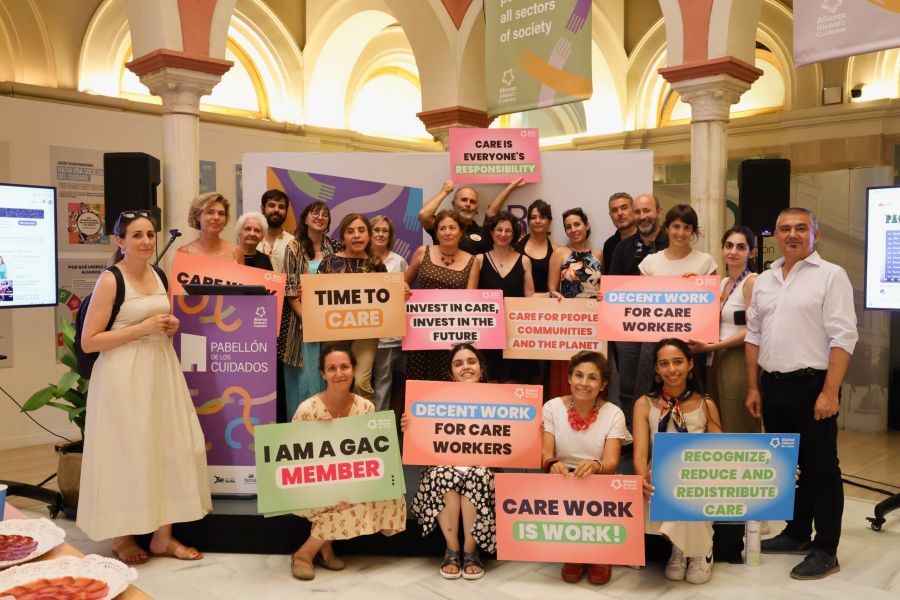
Press Release – July 3 2025– The Care Pavilion closes with a collective call to keep transforming development financing through care
The Care Pavilion closed with a day of reflection, creativity, and political commitment. On the final day of FfD4, transformative narratives, local voices, and strategies were highlighted to keep care at the heart of the global agenda.
Seville, July 3, 2025 — The final day of the Care Pavilion, held alongside the Fourth International Conference on Financing for Development (FfD4), closed with a powerful call for a feminist global economy that puts care at the center.
The “Morning Coffee with the Alliance” kicked off the day with an informal gathering where members of the Global Alliance for Care shared ideas and perspectives on how to strengthen collaboration in the post-FfD4 phase.
Through conversations, creative sessions, and collective analysis, the Pavilion’s agenda explored new narratives and intersectional approaches to care, featuring voices from social movements, public institutions, and international organizations.
The program included a performance on listening and connection by artist Lucía Sánchez, as well as a dialogue on narratives of care and solidarity economies organized by Coordinadora de ONGD and Oxfam Intermón.
The day concluded with the “Post-FfD4 Strategy Session”, which brought together members of the Alliance to reflect on the path ahead and identify concrete strategic actions for the global care agenda.
The official closing celebrated the Care Pavilion as a milestone in international advocacy: a space of collective strength and political imagination that showcased how care is gaining ground in global conversations about development, justice, and sustainability.
The Pavilion, promoted by the Global Alliance for Care with support from UN Women, FAMSI, Seville Provincial Council, and the Spanish Ministry of Equality, hosted 16 events over four days with the participation of more than 60 speakers from 30+ countries.
Across roundtables, panels, and participatory spaces, the Pavilion offered a unique contribution to the FfD4 by making visible the structural importance of care systems in financing and development policy, calling for new cooperation frameworks, feminist economic reforms, and gender-transformative investments.
The Global Alliance for Care ends its participation in the FfD4 with renewed momentum and strengthened partnerships for a shared transformation where care work is no longer invisible, and instead, is recognized as a pillar of equality, prosperity, and life itself.